

- Onions - Instructions for Growing from Sets | Tech Sheet (PDF)
- Onion & Leek Production from Transplants | Tech Sheet (PDF)
- Pelleted Onions | Key Growing Information
- Onions | Key Growing Information
- 4 Great Reasons to Grow 'Blush' Onion
- Overwintering Onions for Spring Harvest | Johnny's Selected Seeds
- Cipollini, Mini & Specialty Onions | Key Growing Information
- Map of Long-Day, Intermediate-Day & Short-Day Onions
- Full-Size Onion Varieties | Comparison Chart (PDF)
- Bunching Onions | Key Growing Information
- How to Grow Scallions • From Seed to Harvest
- Winter Growing Guide | Part 6: Recommended Crops & Varieties
- Classic Storage Crops | Post-Harvest Handling & Storage Guidelines
- Onion Sets | Key Growing Information
Onion Bulb Formation, Daylength & Latitude
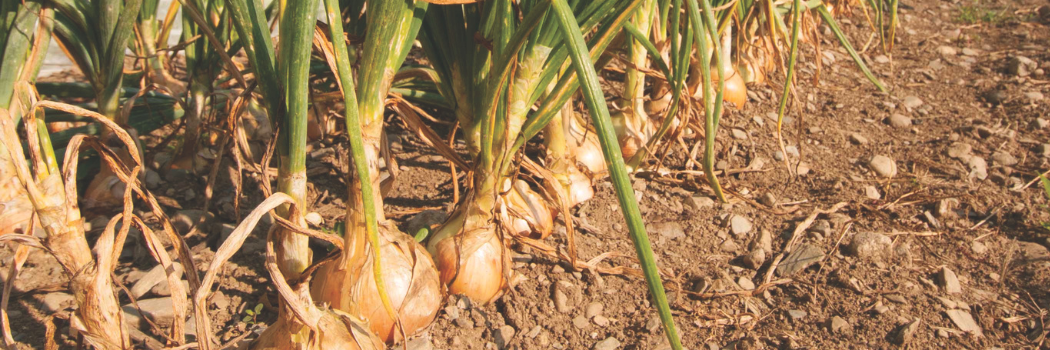
Above: Onion trials at the Johnny's Research Farm.
Map & Key Features of Short, Intermediate & Long-Day Onions
Onions form bulbs in response to daylength. Although temperature and soil fertility also influence onion growth, it is light that acts as the primary driver of bulb initiation. As soon as days reach a certain number of hours in length, onion plants begin to switch their energy from leaf formation to bulb formation. The amount of daylight needed for an onion plant to begin forming a bulb varies by variety. Onion varieties fall into 3 main groups:
On this page we've listed the distinguishing characteristics for each type. Check your latitude, determine your USDA hardiness zone, and consult our onion comparison charts to choose the varieties best adapted to your needs and your region.
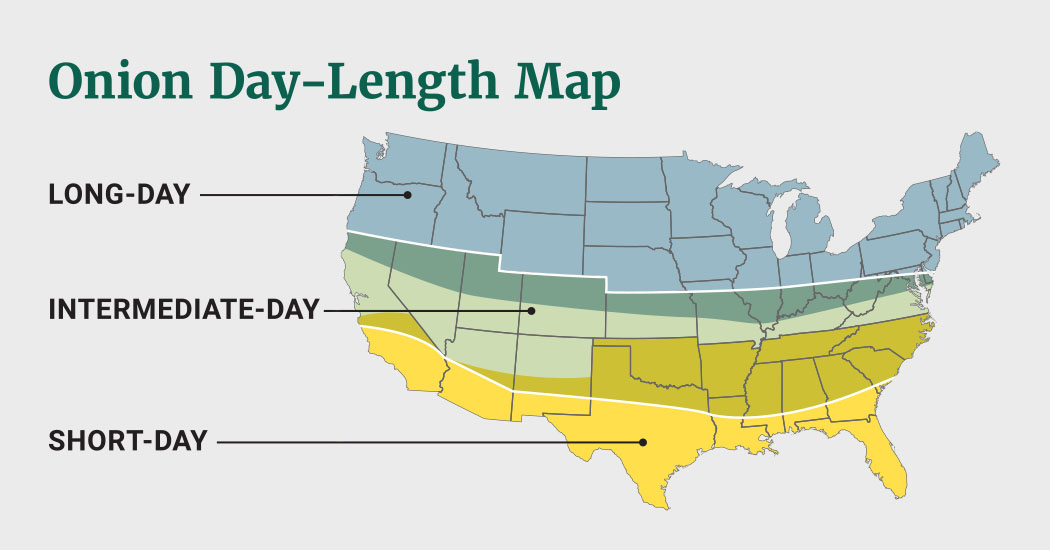
*Zone map is approximate and may vary slightly according to region.
Key Features of Long-Day, Intermediate-Day & Short-Day Onions
Daylength adaptation of onion varieties falls on a continuum, with some overlap rather than distinct boundaries. For example, some long-day varieties may form bulbs farther south than others, and some intermediate-day varieties may form bulbs farther north than others.
Additional environmental factors, such as heat and soil moisture, can affect onion bulbing, so even a properly selected variety needs good conditions for success. Large, healthy tops lead to optimum bulb size and quality, so it is also important to give the onion plant enough time to size up prior to bulbing. Days to maturity can vary widely depending on variety and seasonal culture. Adequate time can be achieved by using transplants instead of, or in addition to, direct-seeding in short-season areas. Johnny's offers many varieties as field-grown plants that are ready for transplanting.
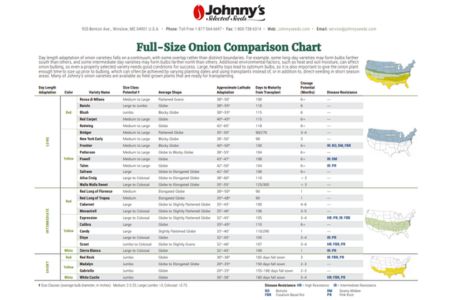
With our Full-Size Onion Comparison Chart, identify the day length adaptation and compare distinguishing characteristics of each of the full-size onion varieties that Johnny's carries.
Long-Day Onions
- Best suited for growing at northern latitudes (37–47°).
- Initiate bulb formation at 14–16 hours of daylight.
- Usually planted in late winter to early spring.
- This type includes sweet, specialty, and long-storage varieties.
- View all Long-Day Onion varieties…
Intermediate-Day Onions
- Best suited for growing at latitudes of 32–42°.
- Initiate bulb formation at 12–14 hours of daylight.
- Usually planted in spring at central latitudes; planted in early spring at northerly latitudes; planted in fall in mild winter climates.
- View all Intermediate-Day Onion varieties…
Short-Day Onions
- Best suited for growing at latitudes of 25–35°.
- Initiate bulb formation at 10–12 hours of daylight.
- Require mild winter climates (Zone 7 and warmer).
- Usually planted in fall and mature in late spring.
- Often sweet or mild in flavor.
- View all Short-Day Onion varieties…
Learn More
- Full-Size Onion Varieties • Comparison Chart Downloadable, Printable PDF
- Onions • Instructions for Growing from Sets Tech Sheet PDF
- Onions Key Growing Information
- Onions & Leeks • Instructions for Growing from Transplants Tech Sheet PDF
- Overwintering Onions from Seed • Recommendations from Johnny's Overwintering Trial Article