

- Introduction to Hydroponics | Johnny's Selected Seeds
- Introductory Hydroponics Information Guide | Printable 4-pp Brochure (PDF)
- How to Grow Healthy Plants in Hydroponic Systems | Seed-Starting & Environmental Variables
- Hydroponic Grow Media | 11 Common Types, Care & Additional Considerations
- Pest & Disease Control Basics in Greenhouse, Hydroponic & Other Protected-Culture Systems
- Pests & Diseases of Greenhouses & Hydroponic Systems | Tech Sheet (PDF)
- Hydroponic & Container Basil Guide | Production Advice & Variety Recommendations
- Digital Hydroponic Head Lettuce Catalog | Johnny’s Selected Seeds
Introduction to Hydroponics
On This Page
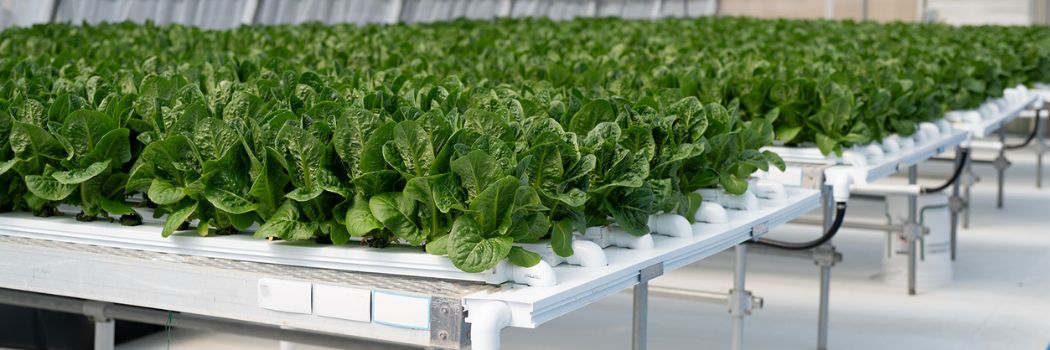
The term hydroponics refers to the practice of growing crops without soil. In contrast to soil-based agriculture, where the plants feed by extracting nutrients from the soil, the roots of hydroponically grown plants are bathed in a complete liquid plant food that contains the essential nutrients.
In place of soil, some hydro systems employ a soilless medium such as rockwool, coconut fibers (coir), or clay pellets to anchor the plants. Other systems contain no solid growing medium, with the roots bathing directly in the liquid. The common thread tying all hydro systems together is that the plants are receiving fertility from the nutrient solution, rather than soil.
Most hydroponic systems are housed under cover, primarily in greenhouses, to allow maximum control over the growing environment. Without the absorptive and buffering effects of soil, any precipitation that falls on an uncovered system would alter the nutrient solution conductivity, throwing the system off balance. Of the hydro systems that are set up outdoors, most are located in arid parts of the world.
Hydroponic systems can be located almost anywhere, including otherwise underused spaces such as vacant lots and rooftops, and areas lacking arable land or an ample water supply. Installations can be scaled to footprints ranging anywhere from hundreds of acres down to inches, or configured vertically, depending on grower needs. Hydroponic culture helps growers avert weeds, soilborne disease, and fertility problems by bypassing soil altogether.
Types of Hydroponics Systems
Between commercially manufactured and homemade hydroponic systems, the equipment can be configured in many different ways, but most hydro systems used to grow food crops fall into two main strategies: those that do include a solid growing medium (also known as substrate hydro systems) in place of soil, and those that do not (also known as liquid hydro systems).
Regardless of the type of hydroponic system, seeds are usually sown in soilless plugs or mats designed to secure the growing plant for the entire cropping cycle. The seeds of long-season fruiting crops are usually sown into small plugs that fit into a larger block, usually a 4" (10cm) cube, to allow the seedling to grow larger before being transplanted into the production greenhouse.
Shorter-cycle crops, such as lettuce and greens, are usually transplanted into the growing system in their original plug without being potted-on to the larger block. The most common materials used for propagation plugs, blocks, and mats are coir, rockwool, or inert foam, such as Oasis cubes.
Substrate-Free / Liquid Hydro Systems (No Solid Medium)
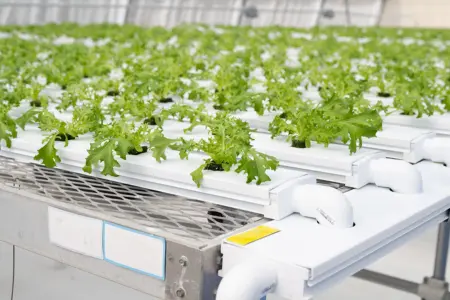
Hydroponic systems where the roots bathe directly in nutrient solution, without any type of solid soil substitute securing the plants, are known as liquid hydro systems. There are many ways to design a liquid hydro system; these are the 3 basic types:
- Nutrient Film Technique (NFT)
The most common hydroponic system used today, NFT systems use long gutters or troughs to hold the plants as they grow. Typically, there is a cover lying overtop the gutter, with holes in which the plants are nested. The roots grow in the gutters without any medium other than a small plug securing the plant in place. Nutrient solution is piped in at the top of the gutter, flows down, and drains at the bottom of the channel. The nutrient film refers to the thin layer of nutrient solution present in the channel where the roots grow. An air pump and air stone (a porous "stone" used to diffuse bubbles of air into the water) are often used to aerate the nutrient solution and increase the supply of oxygen to the roots.
- Deep-Water Culture (DWC)
Deep water culture involves growing crops in standing nutrient solution, with their roots dangling in the solution. Instead of channels, crops grow in tubs or basins, with the plants commonly anchored in floating rafts, with no medium other than the plugs securing the plants in place. Because the roots are submerged, it's critical to provide them with oxygen, typically by means of an air pump and air stone within the reservoir.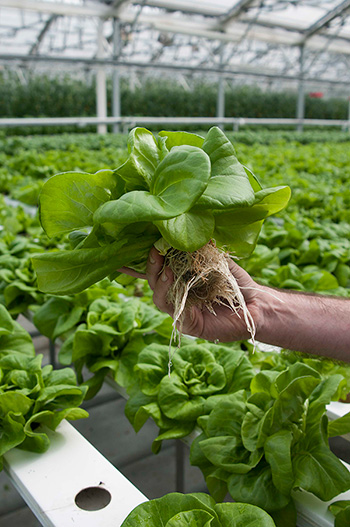
Hydroponic butterhead/Boston lettuce plant. In an NFT system, the roots grow in the gutters without any medium other than a small plug securing the plant in place.
- Aeroponics
Aeroponic hardware designs vary widely, but in all aeroponic systems the crops are held suspended in air and irrigated with a nutrient vapor mist, sprayed at regular intervals. Primary benefits are the greater levels of oxygen available to the roots and significantly less weight in the system.
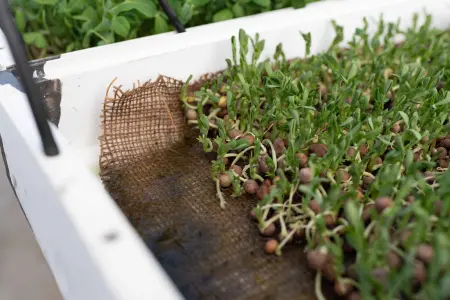
Pea shoots growing in a modfied NFT system at Olivia's Garden, New Gloucester, Maine. Image © Olivia's Garden.
Solid Medium / Substrate Systems
Hydro systems that include growing media can be divided broadly into container culture and slab culture. The medium holding the plant in hydro systems can be composed of a wide range of materials, including burlap, rockwool, coir, hemp, sand, perlite, sawdust, wood chips, or others.
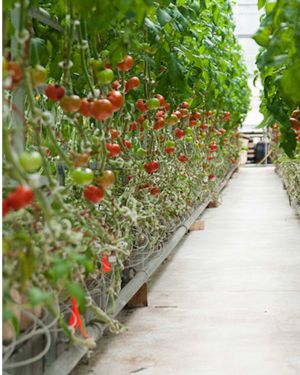
Hydroponic tomatoes in container culture at Olivia's Garden, New Gloucester, Maine. Image © Olivia's Garden.
- Container Culture
Container culture refers to the use of containers to hold the soilless aggregate medium in which the plants grow. The containers can be anything from buckets, pots, or grow-bags specifically manufactured to hold plants, to repurposed bags, buckets, or other alternatives. - Slab Culture
In slab culture, plants are grown in long, flat slabs of media that are made specifically for this application. Commonly available materials for slabs include rockwool, hemp, burlap, and coco coir. Slab dimensions vary by crop and conditions but can range from very thing to a couple inches in depth by a foot or so in width by a few feet in length. Each slab is designed to house multiple plants growing from its top surface, with the number of plants depending on the type of crop. Slabs, especially for larger plants, are wrapped in plastic or biodegradable film, to contain the nutrient solution. Individual slabs are laid end-to-end to form a row.
One big difference between liquid and substrate hydroponic systems is that substrate systems usually require one emitter per container or slab, to deliver the nutrient solution to the roots. This is in contrast to liquid hydroponics, where the nutrient solution is contained in the root zone by the channel or the basin, depending on the system.
Aquaponics
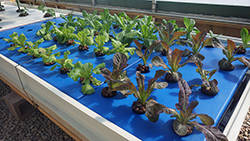
Lettuce at the Aquaculture Centre of Excellence. Image © Aquaculture Centre of Excellence, Lethbridge College.
“ Traceability in food is very important to consumers now, and aquaponics provides maximum nutrition, no pesticides, and freshness…We had our produce randomly tested by the public health authorities, and they came back to us with great results. Clean produce, inside and outside. ”
— Penny Takahashi, Aquaculture Centre of Excellence, Lethbridge College, Alberta, Canada
— Penny Takahashi, Aquaculture Centre of Excellence, Lethbridge College, Alberta, Canada
This methodology involves growing crops with the recycled nutrient waste from aquaculture which is derived directly from the water used to raise the fish or other aquatic animals, creating an efficient food production system that can be integrated with any hydro system. Aquaponic systems can be integrated with any of the above hydro systems.
System Choice
Technically, nearly any crop can be grown in any hydro system. Systems that use media, however, such as slab or bucket culture, are most popular for the fruiting crops: tomatoes, cucumbers, peppers, and eggplant. Liquid systems are the most popular for leafy crops such as lettuce, greens, and herbs. Microgreens and shoots are commonly grown in a modified NFT system, with a piece of burlap, hemp, or other material lining the gutter to secure the roots.
The Growing Differences: Hydro vs. Soil
Attentive Management
As with any other engineered system, hydroponic growing only works as well as the system is designed and managed. Unlike some field crops that can grow with little attention for extended periods of time, hydroponic systems require management on a daily basis. Hydro crops are not typically "watered" but rather uptake water and fertility through a nutrient solution provided on a continual or as-needed basis via a circulating system. With their smaller root volumes and lower buffering capacity than soil-grown crops, hydroponically grown crops are prone to more rapid and drastic consequences when a pump or timer fails or a nutrient solution goes out of balance.
Fertility Programs
Hydro system fertility requirements also vary widely on the basis of crop, growing environment, regional and seasonal factors. Success of the crop is dependent on providing a nutrient solution that matches all of these factors. Beginning hydro growers are encouraged to use a complete fertility program that has been designed by the manufacturer with their circumstances in mind. Once they gain familiarity with how the crops should perform, more experienced growers can blend their own custom fertilizers from single elements on their own.
Popular Crops
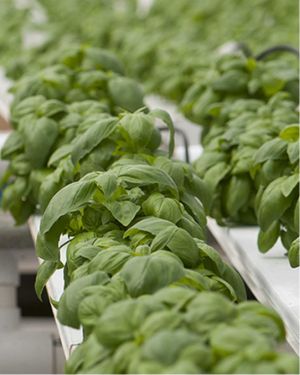
The most popular food crops for hydroponic production are tomatoes, lettuce, cucumbers, greens, peppers, eggplant, strawberries, herbs, microgreens, and shoots. These crops fall into one of two main production models: short-cycle or long cycle.
- Short-Cycle Crops such as lettuce, greens, herbs, and microgreens are quick to reach maturity and provide a high overall yield by being planted and harvested many times over the course of a season. These crops can be scheduled for as many short production cycles as the growing environment permits. Varieties may need to be modified with the changing seasons to maximize year-round production of any given crop.
- Long-Cycle Crops encompass the fruiting crops such as tomatoes, cucumbers, peppers, and eggplant. Depending upon geographic location, these crops are typically grown in two distinct cycles per year (a short summer cycle, followed by a longer winter cycle) or with several staggered successions across the year to extend the harvest.
Living Harvests of Herbs & Microgreens
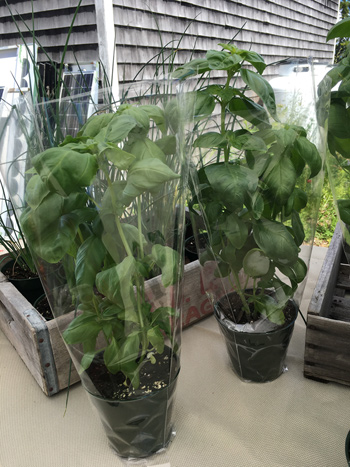
These Basil hydroponic basil plants are an example of a living harvest. Image © Paul Gallione, Johnny's Territory Sales Representative (retired).
The "living harvest" concept is one to which hydroponics is especially well-suited. Since plants can be quickly and efficiently removed from the system with their roots intact, growers can harvest by pulling them from the system for sale as whole plants.
The main advantage of this method is the prolonged shelf life, as the damp roots continue to feed the plant.
Live plant sales are a good option for tender crops such as culinary herbs and microgreens. Basil live plants are typically sold in pots and individually bagged in a protective sleeve. Live microgreens may be sold in clamshells with the media attached.